

E for emotion. E for experience. The next stage has been ignited in the development of the first fully electric high-performance drivetrain from BMW M. With previous tests of the technology demonstrator having exceeded expectations in terms of performance and driving dynamics, the developers are now focused on devising suitable chassis technologies for this new dimension of driving dynamics, finding rubber compounds for tyres that deliver the new drive’s unprecedented torque to the road, and designing an electric motor sound that is as emotive as one would expect from BMW M. To this end, the developers put in plenty of overtime in soundproofed acoustic chambers and on the Nürburgring’s Nordschleife.
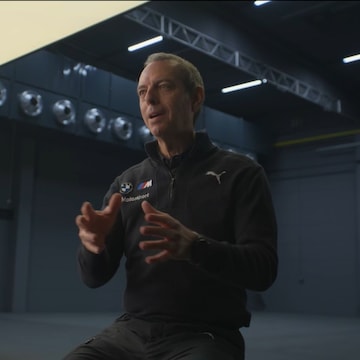
The 'Green Hell' is the main test rig for every BMW M. Every M vehicle, whether it is electric or combustion engine driven, has to go on the Nürburgring and drive 8.000 kilometres.


TEST RIG “GREEN HELL“.


TEST RIG “GREEN HELL“.
8,000 kilometres through the ‘Green Hell’ is the ultimate test a vehicle can be put through under racing conditions. Nowhere else can all the vehicle’s key performance metrics be tried as rigorously as on the Nürburgring’s Nordschleife – one of the most demanding racetracks in the world –, starting with the unrivalled driving dynamics of the new all-electric high-performance prototype. Powered by four electric motors and a central control unit, this delivers perfect torque distribution with no time lag – enabling even higher cornering speeds. According to BMW M CEO Franciscus van Meel, this level of torque vectoring marks the dawn of a new era in vehicle dynamics.
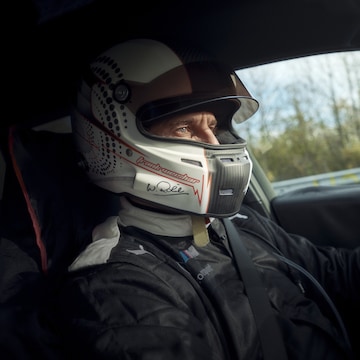
The tears of emotion flow horizontally.


[daɪˈnæm.ɪks]
[automotion] the movement of a vehicle, as well as all the forces and torques acting upon it while in motion.
PUSHING BOUNDARIES.


PUSHING BOUNDARIES.
Pushing boundaries in driving dynamics also mean new, increased physical strain on the vehicle. This is particularly true when it comes to cornering. The optimised load distribution between the outer and inner wheels takes the all-electric BMW M high-performance drivetrain to the next development stage. The individual torque distribution to each wheel literally pulls the model into the corner and increases the wheels’ absolute grip. In practice, this means: braking later before the corner, driving faster through the corner and accelerating sooner out of the corner.
Testing at the Nürburgring revealed that this results in exceptional strain on the chassis and other components, and that existing chassis technologies were no longer sufficient to translate this increased driving dynamics onto the road. For this reason, the BMW M developers had to completely redesign the axles, amongst other things.
In addition, new rubber compounds were required for the tyres, capable of providing the necessary traction to cope with the massive torque of the all-electric high-performance drivetrain. Ultimately, the aim was to achieve a perfect balance between driver feedback, grip and controllability of the drive forces.


ENGINE SOUND AND GEAR SHIFTS.
ENGINE SOUND AND GEAR SHIFTS.
The sound of a combustion engine not only sounds good and brings a smile to the face, it also serves a very practical purpose: it helps the driver gauge their own speed. Naturally, this background noise is absent in electric motors, which merely hum quietly. To address this, the developers tested various concepts for the M model during test drives at the Nürburgring. As part of this, they investigated whether gear changes, common in conventional gearboxes, could also be used in the all-electric drivetrain to assist the driver. And they sought to get to the bottom of the all-important question: what defines the typical BMW M engine sound, and how must its electric counterpart sound so that everyone immediately recognises it as a BMW M?

[daɪˈnæm.ɪks]
[acoustics] describes the difference in volume between the quietest and loudest notes or signals in a sound. It serves as an important compositional tool.
UNRAVELING THE MYSTERY OF THE M SOUND.

UNRAVELING THE MYSTERY OF THE M SOUND.
For the all-electric M High Performance powertrain, the challenge is to find an equivalent to the characteristic combustion engine sound of M models. It is not about recording the sound of an eight-cylinder and emulating it via speakers. Rather, the aim is to create a unique, original sound that makes fully electric BMW M High Performance models sound just as unmistakably ‘M’ as those with six or eight cylinders under the bonnet.
To this end, the sound signatures of models such as the BMW M4 GTS F82 or BMW M3 GTS E92 were recorded using special microphones in the BMW M acoustic chamber and subsequently analysed in complex three-dimensional graphics to determine which aspects make the BMW M engine sound so emotionally engaging.
How does a fully electric high-performance vehicle sound like? The engineers have come a significant step closer to answering that question.
THE M SOUND IN DEVELOPMENT.
Development status: The sound of the ZA0 prototype.
THE IN-DEPTH ANALYSIS.
What is the secret ingredient behind the M sound? The M engineers have brought several legendary M models in front of the microphone and put them through their paces.
_1: V10 engine.
S85 of the BMW M6 Convertible E64.
_2: V8 engine
S65 of the BMW M3 GTS E92.
_3: R6 turbo engine.
S55 of the BMW M4 GTS F82.


